Training Your Own AI Models: A Guide for Developers and Founders
Discover the essentials of training your own AI models. This guide empowers developers and founders to craft tailored solutions for their unique challenges.
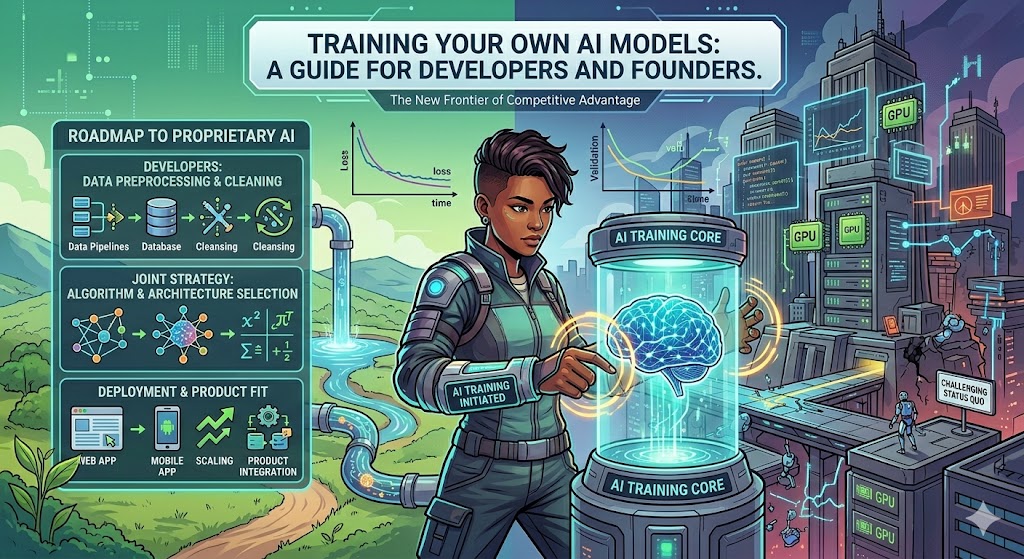
Introduction
Training your own AI models is an exciting frontier for developers and startup founders alike. It allows you to create tailored solutions that can significantly enhance the functionality of your applications. With the rapid advancements in AI technology, understanding how to effectively train your own models is essential for staying competitive in today’s tech landscape.
In this article, we’ll explore the key aspects of training AI models, from data collection to model evaluation, and provide actionable insights to help you embark on this journey. Whether you’re a seasoned developer or an ambitious indie hacker, this guide will equip you with the knowledge to create and train your own AI models.
Why Train Your Own AI Models?
The decision to train your own AI models is driven by several factors:
- Customization: Pre-trained models may not address your specific needs. Training your own model allows you to tailor it to your application's requirements.
- Data Ownership: Using your own data to train models ensures that you fully control the information and its implications.
- Performance: Custom models can outperform generic alternatives, particularly in niche applications where specific insights are required.
- Innovation: Building your own models opens the door to innovation, allowing you to experiment with new ideas and approaches.
Key Steps in Training AI Models
1. Data Collection
The foundation of any AI model is data. Collecting relevant data is crucial, and it should be:
- Representative: Ensure that your dataset reflects the diversity of the problem you want to address.
- High-Quality: Clean, well-structured data leads to better model performance. Consider using data preprocessing techniques to eliminate noise.
- Sufficiently Large: Depending on the complexity of the model, a larger dataset can improve accuracy and generalization.
2. Data Preparation
Once data is collected, it must be prepared for training:
- Cleaning: Remove duplicates, handle missing values, and standardize formats.
- Feature Engineering: Identify and create the most relevant features that will help the model learn.
- Splitting: Divide your dataset into training, validation, and test sets to ensure that the model can be evaluated properly.
3. Model Selection
Choosing the right model architecture is vital. Some popular options include:
| Model Type | Use Case | Pros | Cons |
|---|---|---|---|
| Linear Regression | Simple relationships | Easy to interpret | Limited to linear problems |
| Decision Trees | Classification problems | Intuitive and interpretable | Prone to overfitting |
| Neural Networks | Complex tasks (e.g., image recognition) | Highly flexible | Requires large datasets |
| Support Vector Machines | Classification tasks | Effective in high dimensions | Computationally intensive |
Consider starting with simpler models before progressing to more complex architectures as your understanding grows.
4. Model Training
Training the model involves:
- Choosing a Loss Function: This function quantifies the difference between predicted and actual outcomes.
- Optimization Algorithms: Use methods like Stochastic Gradient Descent (SGD), Adam, or RMSprop to minimize the loss function.
- Training Process: Monitor the training process, adjusting hyperparameters as necessary to improve performance.
5. Model Evaluation
After training, evaluating your model’s performance is critical:
- Validation Set: Use this to tune hyperparameters and prevent overfitting.
- Test Set: Evaluate the model’s performance on unseen data to gauge its generalizability.
- Metrics: Use appropriate metrics (e.g., accuracy, precision, recall) to assess performance based on your specific use case.
6. Deployment
Once satisfied with model performance, the next step is deployment:
- Integration: Incorporate the model into your application’s infrastructure.
- Monitoring: Keep an eye on the model's performance post-deployment to catch and address any issues that arise.
- Updates: Be prepared to retrain your model with new data as it becomes available to maintain its effectiveness.
Challenges in Training AI Models
While the benefits are clear, training AI models comes with its own set of challenges:
- Data Privacy: Ensure compliance with data protection regulations when collecting and using data.
- Resource Intensive: Training complex models can require significant computational resources.
- Expertise Requirement: Developing effective models requires a strong understanding of machine learning concepts and best practices.
Tools and Frameworks for Training AI Models
Fortunately, several tools and frameworks can simplify the process:
- TensorFlow: A popular open-source library for machine learning and deep learning.
- PyTorch: Known for its flexibility and ease of use, especially in research settings.
- Keras: A user-friendly API for building and training neural networks, running on top of TensorFlow.
- Scikit-learn: Ideal for beginners focusing on traditional machine learning algorithms.
Practical Takeaways
- Start Small: Begin with simpler models to build your confidence and understanding.
- Iterate: Training models is an iterative process; don’t be afraid to experiment with different approaches and parameters.
- Leverage Community Resources: Engage with communities, forums, and online courses to enhance your skills and knowledge.
FAQ
Q: How much data do I need to train an AI model?
A: The amount of data required varies based on the complexity of the task and the model used. Generally, more data leads to better performance, but quality is more important than quantity.
Q: Can I train AI models without a background in machine learning?
A: While having a foundational understanding of machine learning concepts is beneficial, many resources and tools are designed for beginners to help you get started.
Q: What are the common mistakes to avoid when training AI models?
A: Common pitfalls include overfitting, using biased data, neglecting data cleaning, and failing to validate models properly.
Q: How often should I retrain my AI model?
A: Retraining frequency depends on how quickly your data changes. Monitor performance and retrain as necessary to maintain accuracy.
Q: Is it worthwhile to use pre-trained models instead of training from scratch?
A: Pre-trained models can save time and resources, especially for tasks where large datasets are hard to come by. Fine-tuning them can often yield excellent results with minimal effort.
Bottom Line
Training your own AI models is a valuable skill that can significantly enhance your applications. By understanding the steps involved—from data collection to deployment—and leveraging the right tools, developers and founders can create customized AI solutions that cater to their unique needs. As the AI landscape continues to evolve, investing time in training your own models will not only boost your technical capabilities but also position you favorably in a competitive market.