Perry: Compiling TypeScript to Executables with SWC and LLVM
Perry combines SWC and LLVM to enable developers to compile TypeScript into executables, enhancing performance and simplifying deployment. Explore its implications.
Introduction
In the fast-paced world of software development, the tools we use can significantly impact productivity and performance. Perry, a new tool in the TypeScript ecosystem, has emerged as a compelling solution that allows developers to compile TypeScript directly into native executables using SWC and LLVM. This innovative approach not only streamlines the workflow but also enhances the performance and usability of applications.
Understanding Perry: The Basics
Perry serves as a bridge between TypeScript and the native executable world. Traditional methods of deploying TypeScript applications involve compiling the code to JavaScript, which is then executed in a runtime environment like Node.js or a web browser. While this method is effective, it introduces additional layers of complexity and can lead to performance bottlenecks.
What is SWC?
SWC (Speedy Web Compiler) is a Rust-based JavaScript/TypeScript compiler that offers significant performance improvements over Babel. It is designed to optimize the compilation process, making it much faster. SWC provides:
- Speed: Compiles TypeScript at remarkable speeds, making it ideal for large projects.
- Transformation: Capable of transforming modern JavaScript and TypeScript into versions compatible with older environments.
- Ecosystem Integration: Easily integrates with existing build tools and frameworks.
What is LLVM?
LLVM, or Low-Level Virtual Machine, is a collection of modular and reusable compiler and toolchain technologies. It is designed to optimize the compile-time, link-time, run-time, and idle-time of code. Key features include:
- Optimization: Generates highly optimized machine code for various architectures.
- Cross-Platform Support: Enables compilation for multiple platforms, thereby enhancing portability.
- Intermediate Representation: Uses an intermediate representation (IR) to facilitate optimizations.
How Perry Works
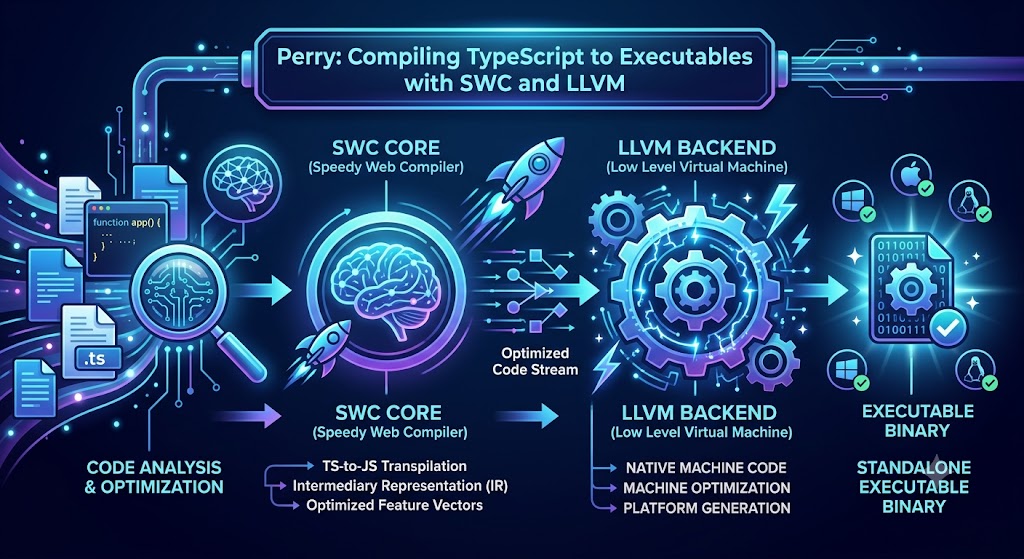
Perry combines the strengths of both SWC and LLVM to create a seamless experience for TypeScript developers. Here’s a breakdown of its operation:
- Code Input: Developers write their TypeScript code as usual.
- SWC Compilation: Perry utilizes SWC to quickly compile TypeScript to an intermediate representation.
- LLVM Optimization: The IR is then passed to LLVM, where it undergoes various optimization processes to generate a native executable.
- Executable Output: Finally, Perry outputs a standalone executable file that can be run on the target operating system without requiring a separate runtime environment.
Benefits of Using Perry
The advantages of compiling TypeScript directly to executables using Perry are numerous:
- Performance: Native executables run faster than interpreted code, significantly enhancing application performance.
- Simplicity: Eliminates the need for a separate runtime environment like Node.js, simplifying deployment.
- Portability: Create executables for different OS platforms while maintaining the same TypeScript codebase.
- Reduced Complexity: Fewer dependencies mean less complexity in managing environments.
Comparison with Traditional Methods
To better understand the impact of Perry, let’s compare it with traditional TypeScript compilation methods:
| Feature | Traditional Method | Perry |
|---|---|---|
| Compilation Speed | Moderate | High |
| Runtime Dependency | Yes | No |
| Output Type | JavaScript | Native Executable |
| Cross-Platform Support | Limited | Extensive |
| Complexity of Setup | Moderate | Low |
Potential Use Cases
Perry opens up a realm of possibilities for developers and organizations alike. Here are some potential use cases:
- Desktop Applications: Create cross-platform desktop applications with a single codebase.
- CLI Tools: Develop command-line interfaces that don’t require installation of a runtime environment.
- Embedded Systems: Build applications for embedded systems where resources are limited.
Getting Started with Perry
For developers interested in experimenting with Perry, the setup process is straightforward. Here’s a quick guide to get you started:
- Installation: Install Perry via npm or download it directly from the official website.
- Configuration: Set up a configuration file to specify your TypeScript sources and desired output settings.
- Compilation: Run the Perry compiler, specifying the entry point of your application.
- Execution: Once compiled, you can execute the output file directly on your target operating system.
FAQ
What types of applications can I build with Perry?
Perry is versatile and can be used to build desktop applications, CLI tools, and even embedded systems applications.
Is Perry compatible with existing TypeScript projects?
Yes, Perry can be integrated into existing TypeScript projects with minimal configuration changes.
How does the performance of Perry executables compare to Node.js applications?
Perry executables generally outperform Node.js applications due to the optimizations provided by LLVM and the absence of a runtime overhead.
Are there any limitations to using Perry?
As with any tool, there may be some limitations in terms of specific TypeScript features or libraries that rely on runtime environments. However, Perry is continually being improved.
How can I contribute to the development of Perry?
You can contribute by providing feedback, reporting issues, or even contributing code to the open-source repository on GitHub.
Bottom Line
Perry represents an exciting development in the TypeScript ecosystem, allowing developers to compile their applications into native executables efficiently. By leveraging the power of SWC and LLVM, it bridges the gap between TypeScript development and performance, making it a valuable tool for indie hackers, startup founders, and mobile developers. As the demand for high-performance applications continues to grow, tools like Perry will likely become essential in the developer toolkit.
If you're looking to enhance your TypeScript workflow, consider exploring Perry and its capabilities. With its promise of speed, simplicity, and efficiency, it might just be the solution you've been searching for.