Gemma 4 12B: Revolutionizing Multimodal AI Without Encoders
Gemma 4 12B is setting new standards in AI with its encoder-free, multimodal capabilities. Explore its features, benefits, and implications for developers.
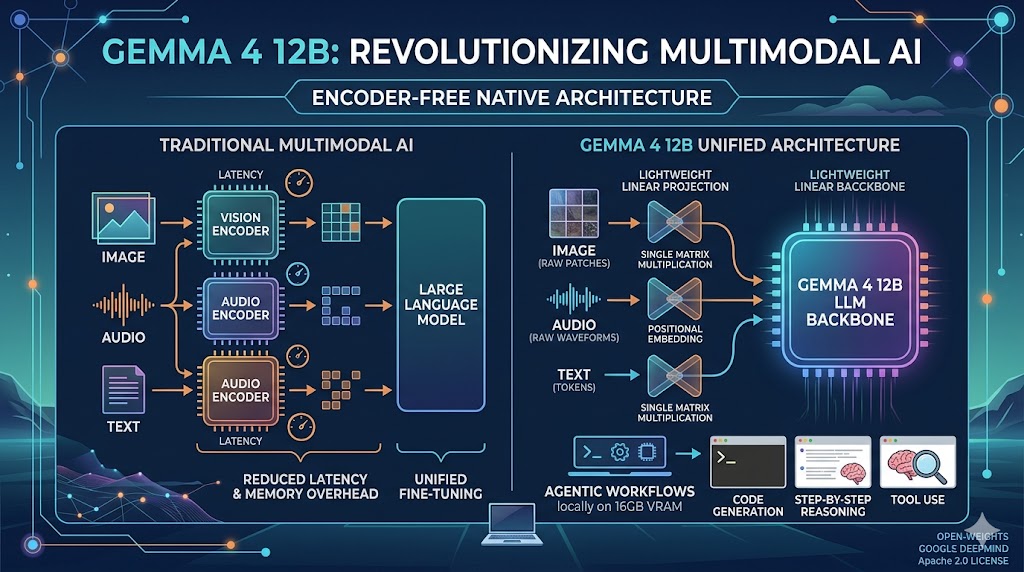
Understanding Gemma 4 12B: The Future of Multimodal AI
In the rapidly evolving landscape of AI technology, Gemma 4 12B emerges as a significant advancement, particularly in the realm of multimodal models. Unlike traditional architectures that rely heavily on encoders, Gemma 4 12B adopts a novel approach that integrates various data types—text, images, and beyond—into a singular framework without the need for separate encoding processes. This shift not only streamlines operations but also enhances the model's adaptability and performance.
What Is Multimodal AI?
Multimodal AI refers to artificial intelligence systems designed to process and understand multiple types of input data, such as text, images, and audio. By leveraging different modes of data, these systems can provide richer, more context-aware outputs. Some key benefits of multimodal AI include:
- Enhanced Context Understanding: By analyzing various data types together, the model can provide more nuanced insights.
- Flexibility in Application: Developers can utilize the model for a wider range of tasks, from content generation to image analysis.
- Improved User Experience: Users benefit from more intuitive interactions, as multimodal systems can better understand varied queries.
Key Features of Gemma 4 12B
- Unified Architecture: The absence of an encoder allows for seamless integration of different data types, making it easier for developers to implement.
- Scalability: The model is designed to scale efficiently, handling a growing amount of data without significant performance degradation.
- Improved Learning Efficiency: By leveraging a unified approach, Gemma 4 12B can learn from various modalities simultaneously, enhancing its training efficiency.
- Cross-Modal Capabilities: Users can expect robust cross-modal operations, such as generating images from text prompts or vice versa.
How Does Gemma 4 12B Compare to Traditional Models?
| Feature | Gemma 4 12B | Traditional Models |
|---|---|---|
| Encoding Requirement | None | Required |
| Integration Complexity | Low | High |
| Learning Efficiency | High | Medium |
| Cross-Modal Functionality | Excellent | Limited |
| Scalability | High | Variable |
Implications for Developers and Startups
For indie hackers and startup founders, the introduction of Gemma 4 12B holds several practical implications:
- Reduced Development Time: With a unified model that simplifies integration, developers can focus more on building features rather than dealing with complex architectures.
- Cost Efficiency: By eliminating the need for separate encoders, startups can reduce computational expenses, making advanced AI accessible to smaller teams.
- Enhanced Product Offerings: The capabilities of Gemma 4 12B open doors for innovative applications, enabling developers to create unique user experiences that leverage both text and visual data.
Real-World Applications of Gemma 4 12B
The potential applications for Gemma 4 12B are extensive, particularly in fields where multimodal understanding is crucial. Here are a few examples:
- Content Creation: Generate rich media content combining visuals and text, useful for marketing and social media.
- E-commerce: Enhance product listings with descriptive images and contextual text, improving user engagement and conversion rates.
- Education: Develop interactive learning tools that utilize text and visuals to provide comprehensive educational experiences.
Challenges and Considerations
Despite its advantages, developers should be mindful of certain challenges:
- Data Privacy: Handling various data types raises questions about privacy and security. Developers must implement robust measures to protect user data.
- Training Complexity: While the model aims to simplify integration, training a unified multimodal model can still be complex and resource-intensive.
- Evaluation Metrics: Assessing the performance of multimodal models can be more intricate than traditional models, necessitating new benchmarks and evaluation metrics.
FAQ
Q: What makes Gemma 4 12B different from previous models?
A: Gemma 4 12B is unique due to its encoder-free architecture, allowing for seamless integration and enhanced learning from multiple data types.
Q: Can Gemma 4 12B be used for real-time applications?
A: Yes, the model's scalability and efficiency make it suitable for real-time applications, providing quick responses to user inputs.
Q: How can startups implement Gemma 4 12B in their products?
A: Startups can leverage the model's capabilities to enhance user experiences, create innovative applications, and streamline development processes.
Q: Are there any limitations to using Gemma 4 12B?
A: While it offers many advantages, challenges such as data privacy and training complexity need to be addressed by developers.
Bottom Line
Gemma 4 12B represents a significant leap forward in multimodal AI technology, offering developers a unified, encoder-free solution that enhances functionality and adaptability. Its potential to streamline development processes and enrich user experiences makes it an exciting tool for startups and indie hackers alike. As the landscape of AI continues to evolve, embracing innovations like Gemma 4 12B could be pivotal in achieving competitive advantages in your projects.