What the Dismissal of Elon Musk’s Lawsuit Means for AI Competition and Developers
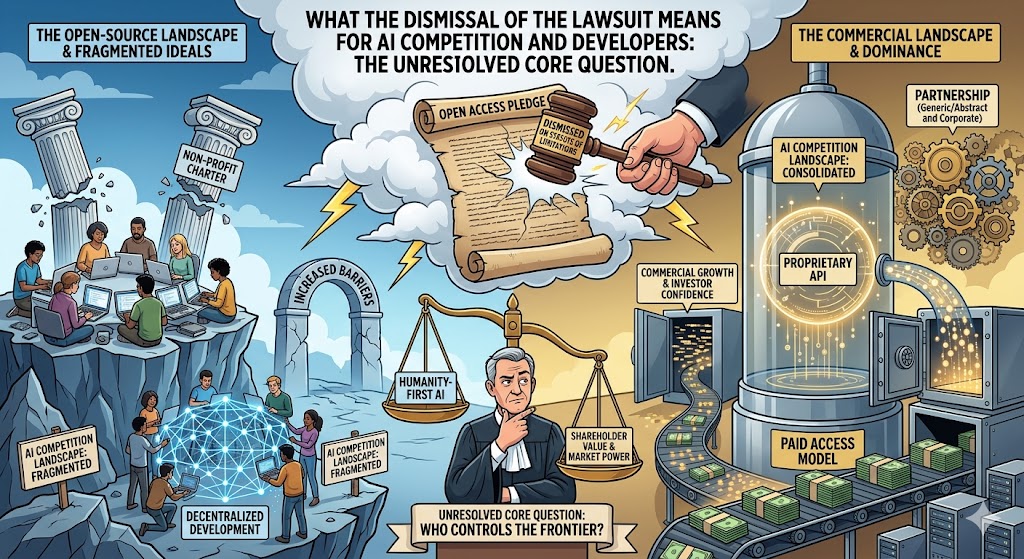
A federal jury has dismissed Elon Musk’s lawsuit alleging OpenAI stole trade secrets. The ruling reshapes the AI rivalry and offers fresh perspective for indie developers and startups.
The Verdict in Plain English
On May 20, 2024, a federal jury in San Francisco ruled that Elon Musk’s lawsuit against OpenAI and its CEO Sam Altman should be dismissed. Musk had alleged that OpenAI stole trade secrets from his now‑defunct venture, xAI, after he withdrew from the board of directors in 2023. The jury found no sufficient evidence of misappropriation and concluded that the claims did not meet the legal threshold for a trade‑secret case.
The decision is a landmark moment for two reasons:
- It curtails the narrative that OpenAI is a "stealing" competitor – a storyline Musk has amplified in public forums.
- It sets a precedent for how courts will treat trade‑secret claims in the rapidly evolving generative‑AI space, where code, models, and datasets often overlap.
Below we break down the legal reasoning, discuss the broader market implications, and give developers a roadmap for navigating the post‑verdict landscape.
Why the Jury Said “No”
1. Lack of Concrete Trade‑Secret Proof
Musk’s team argued that OpenAI accessed proprietary model architecture and training data belonging to xAI. However, the burden of proof in trade‑secret cases lies with the plaintiff to demonstrate:
- Secrecy: The information was genuinely secret and protected.
- Misappropriation: The defendant knowingly used or disclosed the secret.
The jury heard that much of the alleged “secret” material was either publicly disclosed in research papers or shared under non‑exclusive licenses. Without a clear chain of custody, the claim fell flat.
2. No Direct Employee Poaching Evidence
Musk claimed that former xAI engineers moved to OpenAI and took confidential knowledge with them. The defense successfully argued that standard industry hiring practices—including non‑compete waivers and the public nature of AI research—make it difficult to prove that specific code snippets or model weights were copied.
3. Timing and Scope Mismatch
The lawsuit covered a broad timeline (2022‑2024) and a wide array of alleged assets. The jury noted that the scope was too expansive, diluting the focus on any single actionable misappropriation.
“A claim must be specific enough to allow a defendant to respond,” the jury foreperson explained in post‑verdict statements, echoing common judicial guidance.
What This Means for the AI Competitive Landscape
The Legal Landscape Remains Murky
While Musk’s case was dismissed, the underlying tension between large AI labs and independent founders persists. Future litigations may focus on:
| Potential Issue | Likely Legal Angle | Example Scenario |
|---|---|---|
| Data ownership | Copyright / Database Rights | A startup claims a cloud‑provider reused its curated dataset for a competing model |
| Model inversion | Trade‑secret / Patent | An ex‑employee recreates a proprietary diffusion model at a rival firm |
| API misuse | Contract breach | A developer’s API key is used to train a competing service |
Developers should document their IP rigorously—version control logs, access controls, and NDAs are more valuable than ever.
Market Perception Shifts
OpenAI’s public image suffered a brief dip after Musk’s accusations, but the jury’s dismissal reinstates credibility among investors and enterprise customers. For indie developers, this translates to:
- More stable partnership opportunities with OpenAI APIs.
- Reduced risk of sudden policy changes driven by litigation.
- A clearer competitive field where differentiation will rely on product experience, not legal battles.
Practical Takeaways for Indie Hackers & Startup Founders
1. Harden Your Trade‑Secret Strategy
- Classify every piece of code, data, or model as public, internal, or confidential.
- Encrypt and restrict access to confidential assets using role‑based permissions.
- Maintain audit trails (Git commit signatures, cloud‑access logs) to prove ownership if needed.
2. Leverage AI‑Powered ASO Wisely
With OpenAI’s APIs back on stable footing, you can safely integrate LLM‑driven keyword generation and screenshot creation tools (e.g., ScreenMint’s AI screenshot generator) to boost App Store visibility.
- Automate metadata: Feed your app description into an LLM to generate localized keywords.
- Dynamic screenshots: Use AI to mock‑up device frames for multiple screen sizes without manual design work.
3. Diversify Vendor Relationships
Relying on a single AI provider is risky, even after a favorable court outcome. Consider:
- Multi‑cloud strategies (AWS Bedrock, Azure OpenAI, Google Vertex) to avoid lock‑in.
- Open‑source alternatives (LLaMA, Stable Diffusion) for core model tasks.
4. Keep an Eye on Regulatory Trends
The EU AI Act and emerging U.S. AI bills could impose new compliance requirements. Early alignment—data provenance, model explainability, and user consent—will save time and money.
How ScreenMint Fits Into This New Reality
ScreenMint’s platform already automates the generation of App Store and Google Play screenshots using AI, while also handling ASO metadata and publishing. In a post‑verdict environment where OpenAI’s services are less likely to be disrupted, developers can:
- Integrate OpenAI’s language models for copywriting directly within ScreenMint’s workflow.
- Scale screenshot creation across dozens of device form‑factors without hiring a design team.
- Maintain compliance by storing generated assets in a secure, version‑controlled repository.
In short, the legal calm around OpenAI lets you focus on growth rather than litigation risk.
Frequently Asked Questions
Q1: Does the dismissal mean Musk can’t sue OpenAI again? A: The specific claims were dismissed, but Musk could file a new suit if he uncovers fresh, concrete evidence of misappropriation.
Q2: Should I worry about my own AI startup being sued for trade‑secret theft? A: Risk exists, especially if you hire talent from competitors. Mitigate it with NDAs, clear IP assignment clauses, and documented development processes.
Q3: How does this affect pricing for OpenAI APIs? A: No direct impact is expected. Stability in the legal front often translates to predictable pricing and service level agreements.
Q4: Will Apple or Google change their app‑store policies because of this case? A: Unlikely. Their policies focus on user safety and privacy, not on inter‑company AI disputes.
Q5: Can I still use AI‑generated screenshots for app store listings? A: Absolutely. As long as the assets comply with store guidelines (no deceptive content), AI‑generated visuals are permissible.
Bottom Line
The jury’s decision to toss Elon Musk’s lawsuit against OpenAI and Sam Altman removes a cloud of legal uncertainty that hovered over the generative‑AI market. For developers and indie founders, the takeaway is clear: focus on solid IP hygiene, leverage stable AI services for growth, and diversify your tech stack. With tools like ScreenMint handling the heavy lifting of ASO and screenshot automation, you can channel energy into building compelling user experiences rather than watching courtroom drama.